A tale of the transfer of the fair race of our Lord Jesus Christ from Persia to the reigning city of Moscow
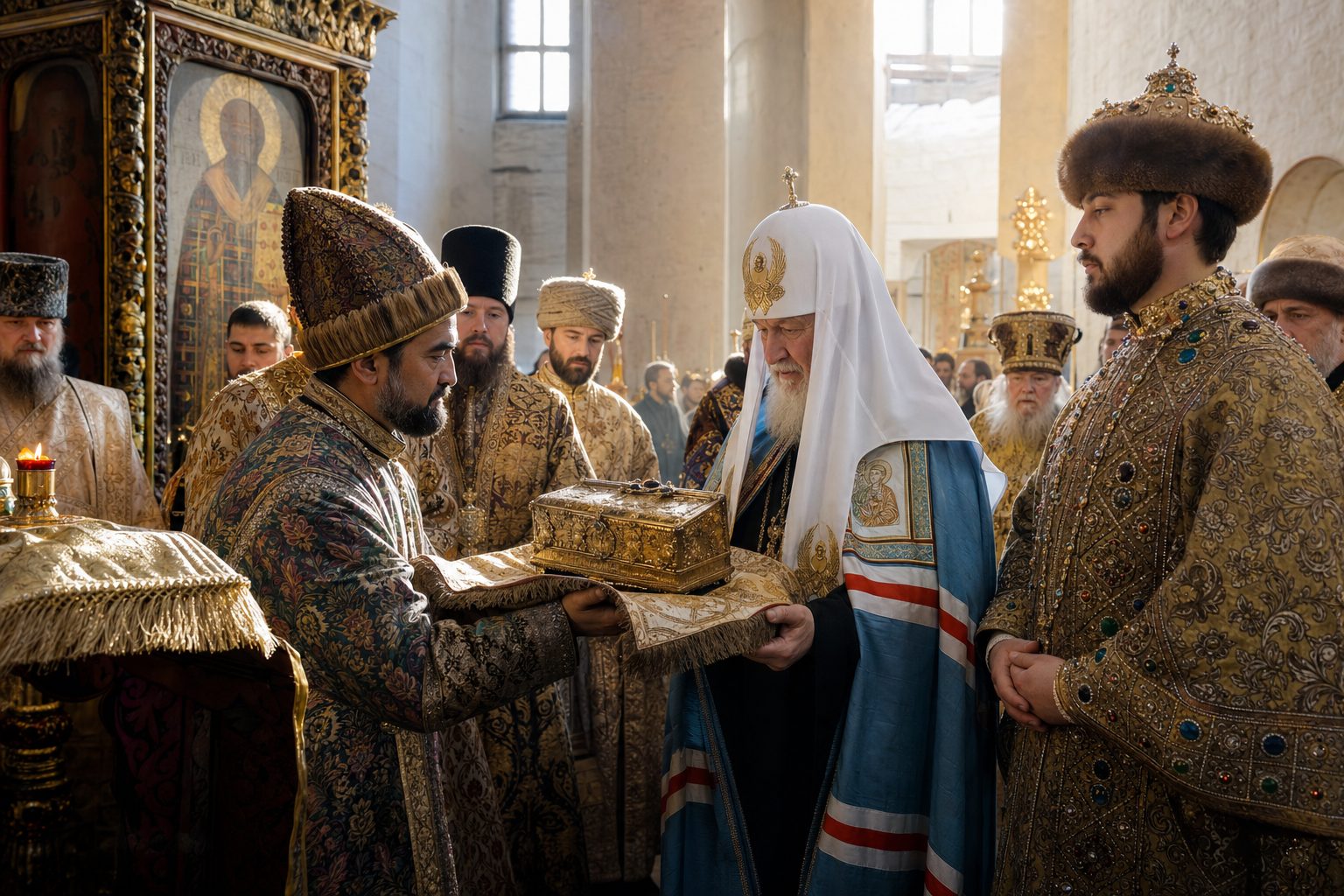
In the days of the good-hearted king and great prince, the autocrat of all Russia, Mikhail Feodorovich, in the patriarchate of the most holy Filaret, the father of the king by flesh and spirit, <unk> in Persia reigned Shah Abbas [Shah Abbas I, by surname Great, ruled Persia from 1586 to 1628 Abbas I was one of the most remarkable rulers of Persia.
He made many beneficial reforms for the country, transformed the military structure of the country, built roads and bridges, took care of the renewal and decoration of cities and tried to revive trade with India and Europe.
He often sent the flocks to other European countries: France, England, Spain and the Netherlands.]; similarly, the Russian tsar sent ambassadors to him with gifts. In the year 7133 from the creation of the world (from the Christmas of Christ in 1625), in March, a certain glorious ambassador by the name of Urusambek from the shah arrived in Moscow to the benevolent king Michael; this ambassador was sent by the aforementioned shah Abbas.
Urosambek brought with him a message and many valuable gifts to the good-hearted king Michael. In addition, he brought with him a message and a precious gift to the most holy patriarch Filaret, namely: the rose of our Lord Jesus Christ, placed in a golden chest decorated with precious stones. In this message the Persian shah announced that the robe of Christ was found, during the conquest of the Iberia country [Iveria <unk> modern Georgia].
It was conquered (not all, but most of it) by Shah Abbas in 1613. The beginning of Christianity was laid in Georgia with the preaching of St. Nina equally apostolic in the beginning of the IV century (her memory <unk> 14 January).
Under Patriarch Peter of Antioch (493-495), a conciliar decree was made that the Church of Iberia should be autocephalous (independent). In 1783, when Georgian King Iraklius recognized the supreme authority of Russia over him, the Iberic High Priests were awarded the title of Members of the World.
In 1811 the Georgian Exarchate was established to govern the Georgian Church.] , in the metropolis treasury, where it was sealed in one of the crosses; taking this rose, the Shah sent it as a gift to the most holy patriarch of Moscow.
And whosoever will not give him glory as God, let him be cast into a burning fiery furnace without mercy; and let him be honored and glorified that kindleeth the fire for such a blasphemer.
His Holiness Patriarch Filaret gladly accepted this great gift, more precious than all earthly, most expensive gifts; then Patriarch Filaret summoned to himself the experienced Greek elders who were then in Moscow; some of these elders came to Moscow from Jerusalem, others from Greek countries; among them was, among other things, Nectarius, later archbishop of Vologda and Great Perm, as well as Ioannikios, who had just arrived in Moscow.
Moscow with His Holiness Theophan, Patriarch of Jerusalem.
The most holy patriarch Filaret asked the Greeks if they knew anything about the Lord's Supper and what was said about it in Greek lands.
When I was an archdeacon in the service of the Patriarch of Constantinople, I was sent by him to the country of Iberia for the church. I happened to be in a church called Illetta, and there I saw a great number of lights on the right side of the first pillar. I asked the priests who were there, "What is this?"
And they said unto me, That the vesture of Christ is laid here. And they said, That one of the soldiers of our country, who was in Jerusalem when the Lord was crucified, brought it, and that many miracles were done by the name of Christ.
Others of the Greeks said to the most holy patriarch that everywhere, <unk> in Palestine as well as in the lands of the Greeks, <unk> the orthodox unanimously affirm that the mantle of the Lord is in Iberia; this soldier received by lot the rice of the Lord [John 19:23-24], after which he took it to his native country <unk> Iberia and gave it here, as a precious gift, to his native sister, a former youth; afterwards this soldier told everyone about what had happened in Jerusalem with the Lord
Jesus Christ.
And when she heard the words of the captain, she loved the ark of the LORD, and kept it in her heart; and the ark of the LORD died, and she made a will to bury the body of the ark of the LORD, and it was done.
During the reign of Constantine the Great, the Greco-Roman emperor [ruled the Roman Empire from 306 to 337] (when Iveria was enlightened by holy baptism), this tree began to flow fragrant and healing myrrh; this myrrh was anointed all who were possessed by any disease or ailment and were healed.
After many years, when the Persians, with God's permission, captured Iberia for the first time, they destroyed the church where the peace tree was located.
As for the Lord's Supper, it was unanimously asserted that it was in Iberia; many believed that it was taken, in the sight of God, during the Persian captivity, by the faithful from that tomb to be preserved in inviolability; and how it was afterwards in the church of the metropolis, <unk> no record of this has been preserved.
The Holy Patriarch Filaret listened to all the reports about the Lord's Supper; then he consulted with the most exalted Russian hierarchs (then it was the time of the holy forty days): on their advice a strict fast and prayer was declared.
Then, after an all-night vigil during the week of the Crusades, the most holy patriarch ordered the rosary of Christ the Saviour and our God to be placed on the sick, just as in ancient times the pious Queen Helena placed the cross of Christ on the dead to prove its authenticity to all.
And as the cross of Christ was then made known by the power of the resurrection of the dead, so now the truth of the Lord's commandment was made known to all, for by it healing and prompt healing were given to all who were sick upon it.
And the good-hearted king and the most holy patriarch were filled with great joy at this grace; then he ordered to arrange in the great cathedral church of the Assumption of the Blessed Virgin Mary, on the west side, in the right corner, an honorable and especially decorated place, where there was the image of the living tomb of Christ.
This cloth is still seen and revered by all; it still gives healing to all the sick who come to it with faith [Today two parts of the Lord's Supper are in Petersburg: one in the Palace Cathedral, the other in the Petropavlovsk.] .
It was established that the feast of the laying on of the Lord's table would be celebrated on the 10th day of the month of July [The event of the laying on of the Lord's table took place in March, during the Great Lent; but for the sake of the Great Lent, the celebration of the laying on of the Lord's table was postponed to the 10th of July; this day was the canon of the solemn day of the coronation of Tsar Michael Feodorovich.
In this service, calling the faithful to worship the Divine and healing robe of the Savior, the Church proclaims that this shirt is a robe, precious and with the power of healing, and because it was worn by the holy and vivid flesh of the God-man.
On the feast of the Lord's Passover, the priest carried it, in the form of a cross, on his head to the middle of the temple for worship.
This can be seen from the letter of the archbishop of Tver to the Eumenian Euphemia. "In the current year of 1626, writes the archbishop, on the 24th day of January, letters were sent to us from the Sovereign Tsar Grand Duke Michael Feodorovich and all Russia and from the Great Sovereign and Father of our most holy patriarch Filaret Nikitich of Moscow and all Russia.
They say: last year, on March 11, 1625 the Georgian ambassador of the Abbas Shah came to the King Michael Feodorovich and the most holy patriarch Filaret Nikitich from Kizil-Bash, and after bowing to the king and the most holy patriarch, he gave the latter a golden ark decorated with precious stones with the shroud of Jesus Christ.
On the same day, at his court, the Great Prince and our father, the most holy patriarch Filaret, with his associates <unk> Cyprian, Metropolitan of Sar and Podon, with Nectarius, Archbishop of Greece, with archimandrites, hierarchs, prototheologians and all the sacred council, examined the ark and saw in it a pattern of cloth, woven, reddish and of ancient years.
On 18 March, the most holy patriarch Filaret spoke to his son, the king and Grand Duke Michael Feodorovich, that the shrine, which is called the Shroud of Christ, was sent from the pagan king Abbas Shah, and that without a true testimony it could not be accepted: the word of unbelievers without a test is not acceptable as a testimony.
Therefore, the council of March 26 from the patriarch, archbishop, archimandrites, and elders in the monasteries laid seven-day fast and prayer, and the clergy of other temples to serve the liturgy and pray that the Lord God about that sanctuary will manifest His will.
By the grace and humanity and the unspeakable mercy of our Lord God and Savior Jesus Christ, many healings were performed by the Lord's grace before the week was completed; and, precisely, to whom, on what day and from what illness, the authentic inscription was sent to us in Tver, with the seal of the Great Tsar and Filaret Nikitich, the most holy patriarch of Moscow and all Russia.
Therefore, I beseech you to gather the hieromonks and brothers together in the cathedral church and to command the chief deacon here to read this letter of ours in the hearing of all the people, and after reading it to make a prayer to the Lord with a bell.
Today, as a sign of our faithfulness to the divine and purposeful plan of our Savior God, who has chosen to bear this flesh and shed His holy blood on the cross, redeem us from the work of the enemy.
The mantle of incorruption, the salvation of all men, the Lord, has given to us Your divine treasure, an honest rose, I am a chthon, I am the living and holy flesh of the incarnation of Your mantle, and You have favored us. With this desire, we welcome the light of celebration, fear and love, to the Merciful as we sing, we call upon You Christ: keep in peace our good-faithful emperor Nicholas Alexandrovich, and the saints, and all the people, by Your great mercy.
I 'm going to have to ...
The trapper, fourth voice.
Tramp, voice 4: Today, as the patron saint of the faithfulness to the divine and purposeful rites of our Savior God, who was pleased to bear this flesh, and to shed His holy blood on the cross, redeem us from the work of the enemy.
The fourth voice.
KONDAK, voice 4: The robe of incorruption, the saving purpose of all men, the Lord, gave to us Your divine treasure an honest rose, I am also a chthon, I am the living and holy flesh of the incarnation of Your robe favored by you: with this desire we celebrate lightly, with fear and love, as a Blessing, we call you Christ: keep in peace our good-hearted emperor Nicholas Alexandrovich, and the saints, and all people, by Your great mercy.
3 Shah Abbas I, nicknamed the Great, ruled Persia from 1586 to 1628. Abbas I was one of the most remarkable rulers of Persia. He made many beneficial reforms for the country, transformed the country's military structure, built roads and bridges, took care of the restoration and decoration of cities and tried to revive trade with India and Europe.
5 Iveria <unk> modern Georgia. It was conquered (not all, but most of it) by Shah Abbas in 1613. The beginning of Christianity was laid in Georgia with the preaching of St. Nina of Equal Apostles in the beginning of the IV century (her memory <unk> 14 January). The Patriarch of Antioch, Eustace (323-340), established an archdiocese in the main city of Mtskheta, which was subordinated first to the Patriarch of Antioch, and then to the Patriarch of Constantinople.
9 Now two parts of the Lord's Supper are in St. Petersburg: one in the Palace Cathedral, the other in the Petropavlovsk Cathedral. 10 The event of the transfer of the Lord's Supper took place in March, during the Great Lent; but for the sake of the Great Lent, the celebration of the transfer of the Lord's Supper was moved to July 10; this day was the canon of the solemn day of the coronation of Tsar Michael Feodorovich.
On the day of the feast of the Lord's Passover, the priest carried it, in the form of a cross, on his head to the middle of the temple for worship. Therefore, in the church hymns we hear the call: "To Your honest cross and the holy Passover we bow, Prelacy, and love we obey". The establishment of this holiday was announced by royal and patriarchal decrees. This is evident from the decree of the archbishop to the Kalazhin strongman <unk> Euphemia.
On the same day, at his court, the Great Prince and our father, the most holy patriarch Filaret, with his associates <unk> Cyprian, Metropolitan of Sark and Podon, with Nectarius, Archbishop of Greece, with archimandrites, archimandrite, archimandrite, archimandrite, archimandrite, archimandrite and all the holy cathedral, examined the ark and saw in it a drawing of the king's son, a red cloth, without the testimony of the martyrs and martyrs. On the 18th day of March, the holy patriarch spoke to Emperor Philaret, saying that it is impossible to accept the word of Christ, which they call the true and unfaithful.
The Patriarch, Archbishop, Archimandrite, and Elders of the monasteries have made a seven-day fast and prayer, and the clergy of the other churches to worship and pray that the Lord God may manifest His will for that sanctuary. By the grace and humanity and unspeakable mercy of the Lord God and Saviour Jesus Christ, many healings have been accomplished by the Lord's providence before the week is over; and to whom, on what day and from what disease, an authentic inscription has been sent to us in Tver, by the seal of the Great Prince and Phileretus Nichiatich, the most holy Patriarch of Moscow and all Russia.