The memory of the holy prophet Amos
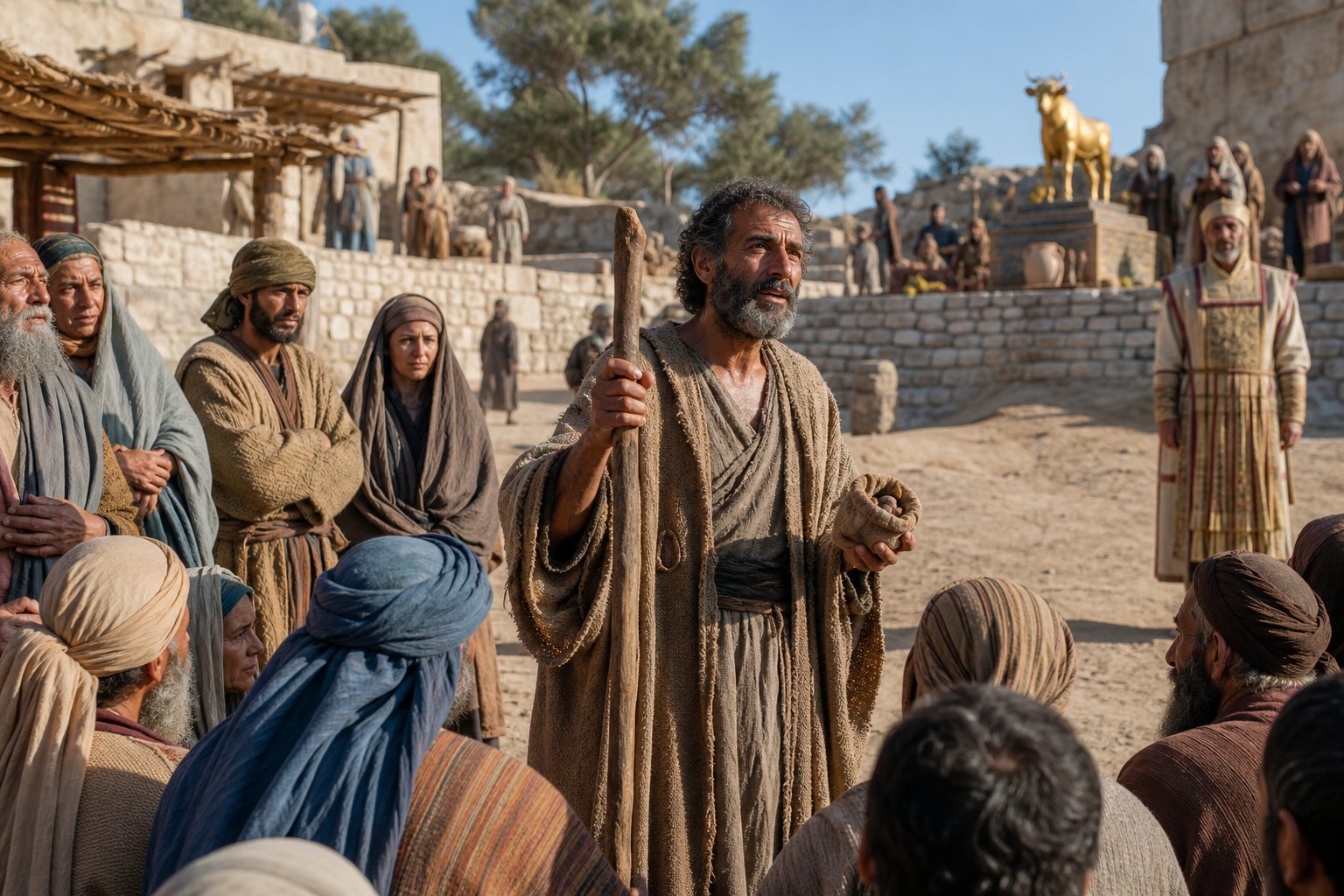
The memory of the 15th of June Holy Prophet Amos, born in the city of Fequia, in the land of Judah, near Bethlehem, came from an insignificant and poor family: he spent his days shepherding sheep.
It should be noted that after Solomon's death (954 B.C.E.), Jeroboam (953-931 B.C.E.) along with the ten tribes of Israel broke away from Solomon's son Rehoboam (954-937 B.C.E.).
The first king of Israel was Jeroboam (1 Kings 3:12). From that time on, the Israelites turned away from true worship and worshiped idols.
Jeroboam, seeking to consolidate his power over the Israelites and fearing that they would again join the king of Judah in going to the temple in Jerusalem for the festivals, overthrowing and killing him, made two golden calves - he knew the inclination of his subjects to idolatry - and their ancestors, coming from Egypt across the Black Sea into the desert, cast out of their golden ears a calf.
Jeroboam set up two golden calves in his provincial cities, one in Dan and the other in Bethel, and commanded the people not to go up to Jerusalem but to worship and sacrifice to the golden calves, celebrating their festivals, saying: "Here are your gods, O Israel, who brought you up out of Egypt". - 3 Ki. 12:28.
And Jehovah sent to them all his holy prophets, to bring them back to the right way; but they turned again to the true God, and worshipped the true God, and the calves of gold; and Jehovah sent his holy servant Amos with all these prophets.
The prophet of God was simple and unskilled in speech, but not in understanding: for the same Holy Spirit was working in him and speaking through him, who was also working in all the prophets.
This is not the same Jeroboam who made golden calves by breaking away from the scepter of Judah, but another, later in years [789-737 B.C.E.]; yet, like his namesake predecessor, he was an idolater who served golden calves.
And St. Amos began to prophesy in the days of these kings, two years before the terrible earthquake in Palestine, which, according to the reports of the ancient writers, was the following:
When the priests objected, he threatened them with death, and at the same time a terrible earthquake struck Jerusalem and all Palestine, not only destroying many buildings, but even moving some mountains from their places.
In the book of Ecclesiastes, we read that the temple was shaken by an earthquake, and that the temple's roof was split open, and the sun's rays fell on the king's face, and immediately the king's forehead was covered with leprosy, so that the Lord could not tolerate the violence against His altar and the disgrace inflicted on His priests.
In his prophetic speeches, detailed in the book bearing his name, St. Amos warned of terrible calamities from God that would come not only upon Israel but also upon the surrounding lands, cities, and peoples: Syria, the Philistines, Tyre, Edom, the Ammonites, and Moab, and especially Israel, because after knowing God, they turned away from him.
And he brought them out of the land of Egypt, and led them through the sea as on dry land, and gave them manna in the wilderness, and water in the rock, and drove out nations before them, and brought them into the land that floweth with milk and honey.
And they made a feast of the golden calf, and said, This is thy god, O Israel; and they made a feast of it in the high mountain of Bethel, where the golden calf stood.
And when the priest of the calf was in Bethel, and saw that Amos the prophet of God blasphemed the idol, and rebuked the calf-sacrifices, and turned away the people from the unclean festivals, declaring the terrible judgment of God upon the worshipers, the priest slandered him to Jeroboam king of Israel, saying, Amos, he is provoking a rebellion against thee in the midst of the house of Israel; the land cannot bear all his words; for thus saith Amos, Jeroboam shall die by the sword, and Israel.
He will be driven from his land.
Amaziah, the priest, tried to provoke the king's anger against the prophet Amos, but the king paid little attention to the priest's words. Although he was an idolater, he respected God's prophet and did not want to disturb him.
And the priest saw that he could not restore the king's strength against the man of God, and he began to drive him with violence, and he smote the holy man, and banished him from Bethel, and forbade him to come to the feast of the golden calf, and to take away the people from the feast of sacrifice and rejoicing; and the holy prophet disregarded the commandment of the priest, and the wounds which he received; and he came again to Bethel, and prophesied again to the people, and instructed them, and warned them.
And the priest took him again, and smote him.
One day a wicked priest pleaded with St. Amos: "O man of vision, go, get yourself into the land of Judah, and there eat bread and there prophesy, but in Bethel do not prophesy anymore, for it is the king's sanctuary and the king's house". And Amos answered and said to Amaziah: "I am no prophet, neither am I the son of a prophet, but I am a herdsman and a gleaner of sycamore figs.
And Jehovah took me from following the flock, and said unto me, Go, prophesy unto my people Israel; and now hear the word of Jehovah. Thou sayest, Prophesy not against Israel, and utter not words against the house of Isaac.
Therefore thus saith Jehovah: When the Assyrians come into the land of Israel, and take it, and desolate its cities, and take this city, then shall a band of uncircumcised men profane thy wife before thine eyes, because thou hast caused Israel to commit fornication before Jehovah, who seeth all things, and hast taught them to commit abominations in the house of the golden calf, thy god; and thy sons and thy daughters shall fall by the sword before thine eyes, and thou shalt die in the midst of the land.
And Israel shall go into captivity out of his land".
And the priest's son, Uzziah, in his anger, smote Amos between the eyebrows with a heavy club, and wounded him mortally; but he died not at once, but was carried alive into the land of Judah, and died in his native city of Pekah, where he was buried with his fathers.
Whoever wishes to see the prophecies of St. Amos can find them in his book; we praise God, who gave him wisdom, now and forever and ever. Amen.
The condac, voiced four.
Kondac, verse 4: Having purified with the Spirit, prophesy, your light-lit heart, glorious Amos, the gift of prophecy above reception, recited it loudly in the lands: He is our God, and will not be attached to Him. _________________________________________________ __________________ 1 789-737 B.C. 2 C.E. lepered. 3 The Jewish historian Josephus (died in the 2nd century B.C.E.), among other things, reports that an earthquake to the west of the temple repelled half the mountain, which, turning eastward for 4 stages, slumbered on the path to the royal gardens.